What Collectors Actually Look For At A Group Show (And How To Price For Them)

What Collectors Actually Look For At A Group Show (And How To Price For Them)
Artists spend years thinking about their work and almost no time thinking about the person who might buy it. This guide flips the room. Here is what collectors are looking for when they walk into a group exhibition, drawn from six years and hundreds of opening nights across the Streeters Gallery and The Holy Art network, and how to price, present and behave so your work is the one they take home.
Who is actually in the room
The collector at a group show is rarely the stereotype. Most are first time or early buyers: people who love art, have a wall to fill and a budget of a few hundred to a couple of thousand pounds, and who come to group shows precisely because the prices are accessible and the discovery is real. Art advisors and curators come too, scouting names for later. The mix is why group shows produce so many first sales for emerging artists.
Group shows work for buyers for a simple reason: thirty artists in one room means thirty chances to fall for something in a single evening.
What stops a collector in front of a work
Feeling first. Collectors buy what makes them feel something, not what is most technically accomplished. An honest, emotionally clear piece outsells a flawless but empty one every time. This is the most consistent pattern across the network.
Coherence. When an artist's two works clearly belong together, the collector reads a voice, not a lucky accident. That confidence makes buying easier.
Presentation. Clean edges, secure fixings, considered framing or deliberately none. Sloppy presentation makes collectors doubt the work and the artist.
A visible price. Price on request kills sales. Collectors at group shows will not chase you for a number. A clear, realistic price on the label is an invitation.
The artist being present. At every opening, the artists who talk sell more than the artists who hover by the door. A collector who has met you is buying a story as well as an object.
How to price for a group show
Pricing is where most emerging artists lose sales, in both directions. Too high and the first time buyer walks. Too low and the experienced buyer wonders what is wrong with it.
Research artists at a similar stage selling similar sized work in a similar medium, and price in that range. As a starting point for emerging artists:
Small works under 40cm: £150 to £400. Medium works 40 to 80cm: £400 to £900. Large works up to the 80cm show limit: £900 to £2,000.
Adjust for medium and materials, but stay inside the range where a first time collector can say yes on the night. Remember that at Streeters and The Holy Art commission is zero, so a £600 sale is £600 to you. You are not pricing to cover a gallery cut.
One more observation from the network: smaller works sell in far greater numbers at group shows than large statement pieces. Bring the big piece for presence, and a smaller one for the sale.
Make the sale easy
Every barrier between "I want this" and "it's mine" costs you buyers.
Label clearly: name, title, medium, dimensions, price. Have a way to take payment on the spot, whether a card reader, payment link or bank details ready on your phone. Know your answer to "can I take it home tonight" (the gallery's collection rules apply) and to "do you deliver". And have somewhere to send the collector who wants to think about it, which is where Mostra comes in: a zero commission studio where they can buy your work a week later, with you keeping 100 percent.
What collectors remember after the show
They remember the artist who was easy to talk to, the piece that had a clear price, and the name they could find again. Follow up within a few days with anyone who showed interest. A simple message, no hard sell. A surprising share of sales happen in the week after a show, and almost all of them go to artists who followed up.
Why this matters more at a real show than online
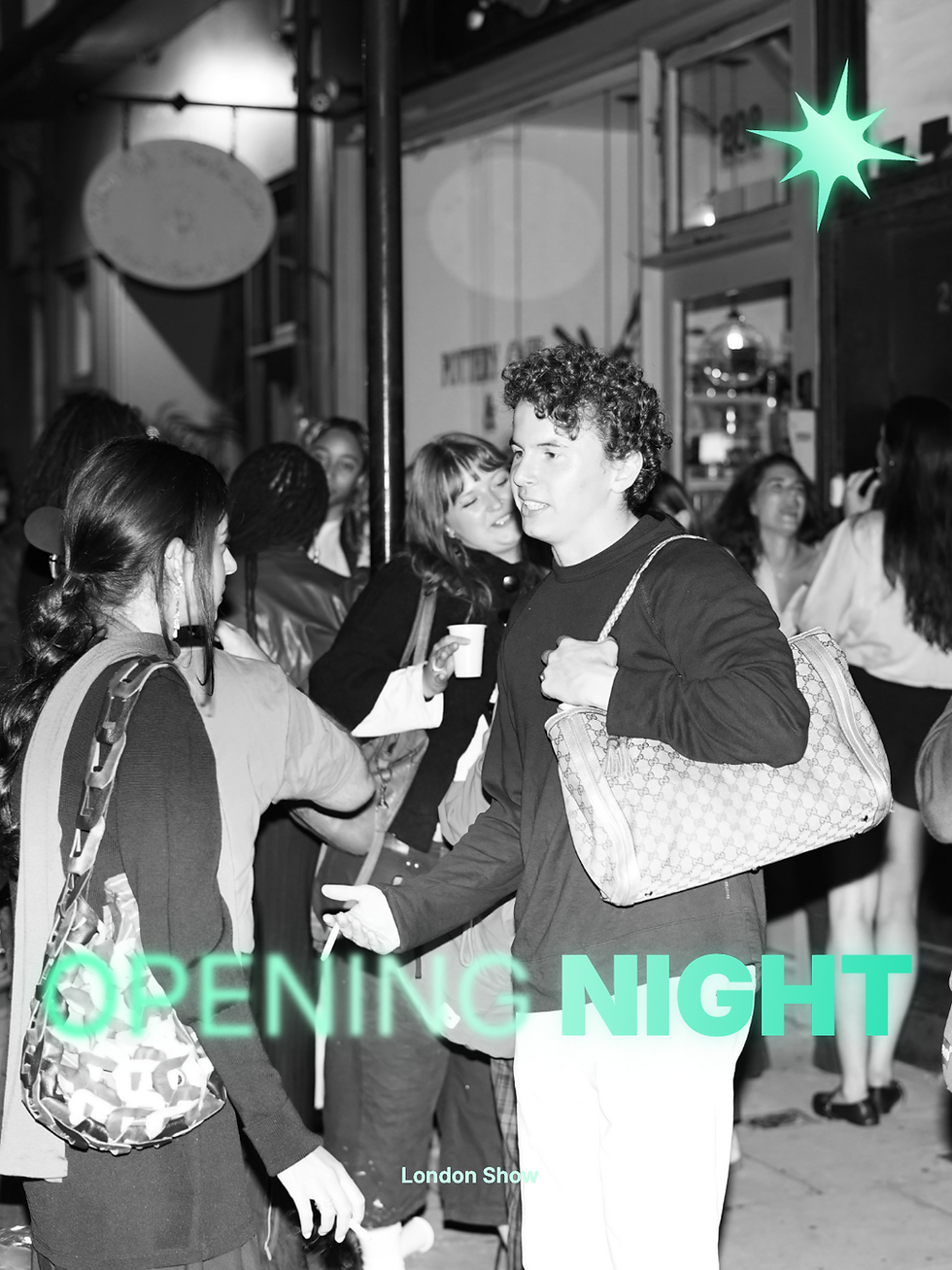
A collector scrolling past your work on a phone is a fraction of a second of attention. A collector standing in front of it at 101 Reade St in Tribeca, or a London opening night, with a drink and time, is a decision in progress. Physical presence is why exhibitions convert and feeds do not.
That is the whole case for exhibiting: put the work where buying decisions actually happen, then make the decision easy.
Frequently asked questions
What do collectors look for when buying art at a group exhibition? Emotional impact first, then coherence across the artist's pieces, clean presentation, a visible realistic price and the chance to meet the artist.
How should I price my art for a group show? In the range comparable emerging artists charge for similar work: roughly £150 to £400 for small works, £400 to £900 for medium, £900 to £2,000 for large. Price visibly. At Streeters Gallery and The Holy Art commission is zero, so the price is what you receive.
Do collectors buy from unknown artists? Yes. Group shows are where most first time collectors buy, and where advisors and curators scout new names.
Should I attend my opening night? If you can. Artists who are present and approachable consistently sell more than artists who are not.
What if a collector wants to buy after the exhibition? The gallery connects enquiries to you directly with zero commission, and a Mostra studio gives collectors a permanent place to buy year round.
Get in the room
Streeters Gallery: London November 6 to 8, New York Tribeca November 20 to 23, Berlin December 5 to 7. Zero commission on every sale.
The Holy Art: rolling open calls across nine cities, free to submit.
Mostra: sell direct, keep 100 percent, own your collectors.
The collector is already looking. Give them something to find.

Comments